Nebulizer Industry News 2026: Market Trends, Tech Innovations & Regulatory Updates
The global nebulizer market continues to evolve rapidly, driven by technological breakthroughs, shifting healthcare delivery models, and the rising prevalence of respiratory diseases worldwide. This roundup covers the latest developments every medical device professional-and online retailer-should know.
Market Overview: Steady Growth Ahead
Market research firms broadly agree that the nebulizer market is on a solid growth trajectory, though estimates vary by definition:
Fortune Business Insights valued the global nebulizer market at $976.46 million in 2025 and projects growth to $1,665.04 million by 2034, representing a CAGR of 6.30%-7.
The Business Research Company estimates a larger market of $1.4 billion in 2025 growing to $1.52 billion in 2026 at a stronger CAGR of 8.7%, reaching $2.07 billion by 2030-2. 360iResearch provides the highest estimate, valuing the nebulizer market at $2.87 billion in 2025 with a projected CAGR of 6.93% to $4.59 billion by 2032-3.
Regionally, North America dominates with approximately 45% of global market share, supported by strong reimbursement policies and high asthma/COPD prevalence-7. The U.S. alone has over 25 million asthma patients, while COPD affects nearly 65 million people globally-1. According to the World Health Organization, about 262 million people worldwide were living with asthma in 2019-7.
Key Market Drivers
Several macro factors are fueling nebulizer demand:
- Rising prevalence of chronic respiratory diseases, driven by air pollution, smoking, aging populations, and environmental triggers-1.
- Shift toward home healthcare: Hospitalization costs for COPD in the U.S. average approximately $19,000 annually, while home care visits cost significantly less-an economic disparity driving demand for portable home-use nebulizers-1.
- Telemedicine expansion: The proportion of U.S. medical claim lines involving telemedicine rose from 5.5% to 5.9% between December 2022 and January 2023 (a 7.3% national increase), enabling remote monitoring for chronic respiratory management-2.
Technology Trends: Mesh Nebulizers Take Center Stage
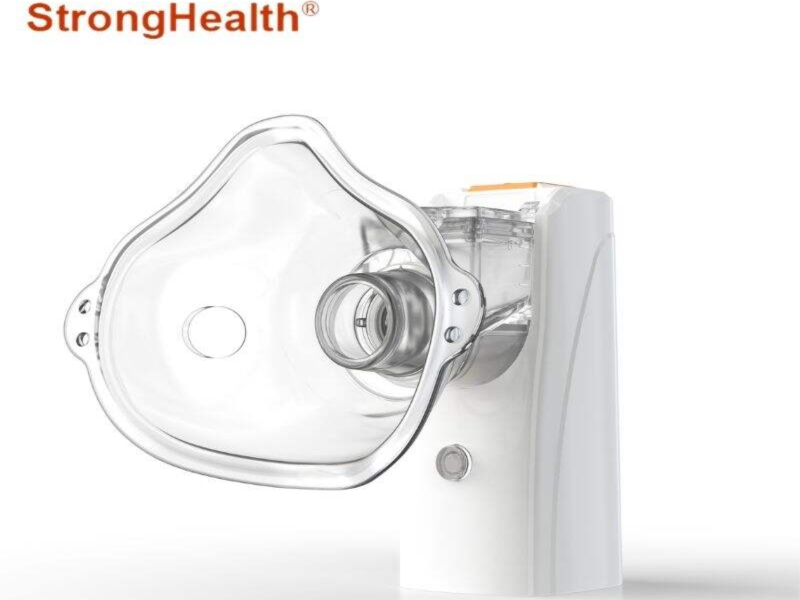
The most significant technology shift is the rapid adoption of vibrating mesh nebulizers (VMNs). These devices offer quieter operation, consistent particle size delivery, improved portability, and enhanced patient comfort compared to traditional jet nebulizers-1. While jet nebulizers still hold the largest revenue share (about 64.8%) due to low cost, mesh nebulizers are expected to register the highest CAGR going forward-7.
Recent Scientific Breakthroughs
- PubMed Study (2025) – Inspiration-Synchronized Small-Particle VMN: A 2025 study published in the Journal of Aerosol Medicine and Pulmonary Drug Delivery compared aerosol delivery via high-flow nasal cannula (HFNC) with inspiration-synchronized VMNs versus continuous VMNs. Results showed that when the VMN was placed near the nasal cannula, the inspiration-synchronized VMN delivered greater inhaled doses than the continuous VMN, regardless of aerosol particle sizes or HFNC flow rates. The study also found that a prototype VMN <3 μm
- Valved Holding Chamber (VHC) Study (2025): Researchers found that attaching a valved holding chamber to VMNs increased total drug delivery by 30–300% and pulmonary drug availability by 50–350% when nebulizing budesonide suspensions-a significant advancement for asthma and COPD treatment-10.
Smart & Connected Nebulizers
Digital adherence tools and smart nebulizers are gaining traction, offering enhanced patient compliance and monitoring capabilities. The smart nebulizer market is projected to grow at a CAGR of 12.80% through 2030, driven by increasing consumer awareness and demand for home healthcare solutions-.
Key trends in the forecast period include:
- Rising adoption of portable and smart nebulizer devices
- Growing integration of connected and app-enabled nebulizers
- Expansion of mesh nebulizer technology
- Enhanced focus on patient convenience and treatment compliance-2
Regulatory Updates & FDA Clearances
-
FDA 510(k) Clearance – HCmed AdheResp® (July 2025)
HCmed Innovations announced that its AdheResp® adaptive breath-actuated mesh nebulizer has received FDA 510(k) clearance-the world’s first breath-actuated mesh nebulizer with built-in connectivity. Key features include:
- Aerosol generation exclusively during inhalation, reducing medication waste and minimizing fugitive emissions into the environment
- No heat accumulation during nebulization, offering advantages for temperature-sensitive biologics such as mRNA or antibody-based therapies-23
-
Ready for large-scale manufacturing to support pharmaceutical partners in clinical trials
This clearance is expected to help pharmaceutical companies reduce development costs, strengthen IP protection, and create differentiated market value-23.
-
FDA Consensus Standards Update (May 2025)
The FDA recognized updated consensus standards for nebulizing systems, specifying requirements for safety and performance testing of general-purpose nebulizing systems intended for continuous or breath-actuated delivery-.
Industry News & Strategic Moves
- Respiratory Care Market Expands
- Jumao & Homed Partnership (June 2026): The two companies formed a partnership to design, manufacture, and distribute a comprehensive portfolio of portable oxygen concentrators, adding to Jumao’s existing respiratory product platform-.
- ResMed’s Smart Device Strategy (June 2026): ResMed continues its "smart devices and big data" approach, with cloud-connected devices enabling physicians to monitor patient compliance and encourage continued use. Higher adherence supports both reimbursement rates and the resupply of masks and accessories-57.
- REMSleep’s DeltaWave Clearance (January 2026): The original 510(k) clearance for DeltaWave, previously limited to home use with CPAP devices for OSA treatment, has been broadened for expanded indicated use-.
-
Chinese Manufacturers Gain Global Traction
Cofoe Medical (可孚医疗) – AI Ventilator Success: Cofoe Medical’s AI-driven ventilator C11, featuring a "dual AI engine" architecture (cloud health big data model + edge-side smart synchronization algorithm), achieved 10,000 unit production milestone within one month of launch. With ultra-quiet technology controlling noise at just 23 dB, the device debuted on JD Health and topped its category within 3 minutes, breaking overseas brands’ long-standing monopoly in the high-end ventilator market-. This signals Chinese manufacturers’ growing competitiveness in global respiratory care.
-
Aerogen Pro-X1 Controller System – FDA 510(k) Summary (September 2025)
Aerogen Ltd received 510(k) clearance for its Pro-X1 Controller System, a Class II nebulizer device suitable for adult and pediatric patients (≥3 years old) in hospital, home, and sub-acute settings-.
Emerging Opportunities & Challenges
Opportunities
- Drug-device combination products are expected to create new market opportunities, with pharmaceutical partners increasingly seeking customized nebulizer solutions for novel biologics-29.
- Emerging markets present significant growth opportunities due to improving healthcare infrastructure and rising awareness of advanced treatment options-.
- Portable and smart devices increasingly dominate purchasing decisions: approximately 53% of U.S. purchasing decisions are influenced by device portability and ease of use-5.
Challenges
- Infection risk remains a concern: nebulizers can pose infection transmission risks due to aerosol generation and unsterile components, a factor highlighted during the COVID-19 pandemic-1.
- Drug loss during nebulization remains a major restraining factor, though mesh nebulizer technology is addressing this with more accurate dosing and lower residual volumes-29.
- Tariff impacts on supply chains: 2025 tariff measures are reshaping sourcing strategies, pricing, and supply-chain resilience-a core operational priority for manufacturers-3.
Competitive Landscape
The nebulizer market remains moderately concentrated. According to market research:
- Global key players include PARI GmbH, Omron, Philips Respironics, Drive DeVilbiss Healthcare, Yuwell, Beurer, Allied Healthcare, Cofoe, HONSUN, Folee, and Medel S.p.A.--64
- The top five manufacturers collectively hold approximately 50% of the global market share-64.
- North America is the largest market, accounting for about 40% share, followed by Europe at approximately 30%-64.
- Asia-Pacific is the fastest-growing region, driven by improving healthcare infrastructure and rising chronic disease prevalence-48.
Outlook
Looking ahead to 2030–2035, the nebulizer industry will be shaped by several key forces:
- Continued miniaturization and portability advances
- Digital health integration – from adherence tracking to remote monitoring
- Biosimilars and biologics driving demand for advanced delivery systems
- Value-based care models requiring demonstrable clinical outcomes
- Sustainable design and infection-control innovations
The COVID-19 pandemic has permanently shifted respiratory care toward home-based settings, a trend that shows no signs of reversing. As portable, smart, and mesh technologies continue to mature, both patient convenience and treatment efficacy will improve-creating significant opportunities for manufacturers, distributors, and retailers serving this dynamic market-29.


 EN
EN
